Peptide Pureness Guide 98%, 99% & Research-grade Described Prg
Air Conditioning Peptide Testing Labs Third-party Peptide Evaluation
- This post is attended to educational and study referral purposes just.
- A solid examination report can sustain pureness, identity, and batch traceability.
- Peptide pureness is an important quality metric that informs you what portion of a peptide example is the intended item versus undesirable by-products.
- Lots of peptide producers or vendors will certainly offer a COA (Certification of Evaluation), as an example our bpc 157 tb 500 blend, that includes the pureness percentage by HPLC and identification confirmation by MS for every set.
Can Hplc Find Peptide Degradation?
Inconsistent Analytical Chemistry fragment size circulation and morphology can impact bioavailability and security. BOC Sciences is geared up with instruments like DLS, TEM, SEM, and so on, to completely evaluate nanoparticle dimension, distribution, and microstructure. For us, pureness isn't simply a percentage-- it's a guarantee of honesty, uniformity, and regard for the science being done.
FDA and the European EMA have established guidelines mandating thorough evaluation and quality control for peptide products to guarantee security and effectivenessr. In the context of pharmaceutical or clinical-grade peptides, lab validation is integral to meeting these guidelines. For instance, prior to a peptide medicine can get in human tests, its producer must show the identification, purity, strength, and safety of the peptide via verified logical techniques. Peptide pureness testing data are obligatory in preclinical research studies and need to be consisted of in investigational new medication (IND) applications and later on new drug applications (NDAs).High-performance Fluid Chromatography
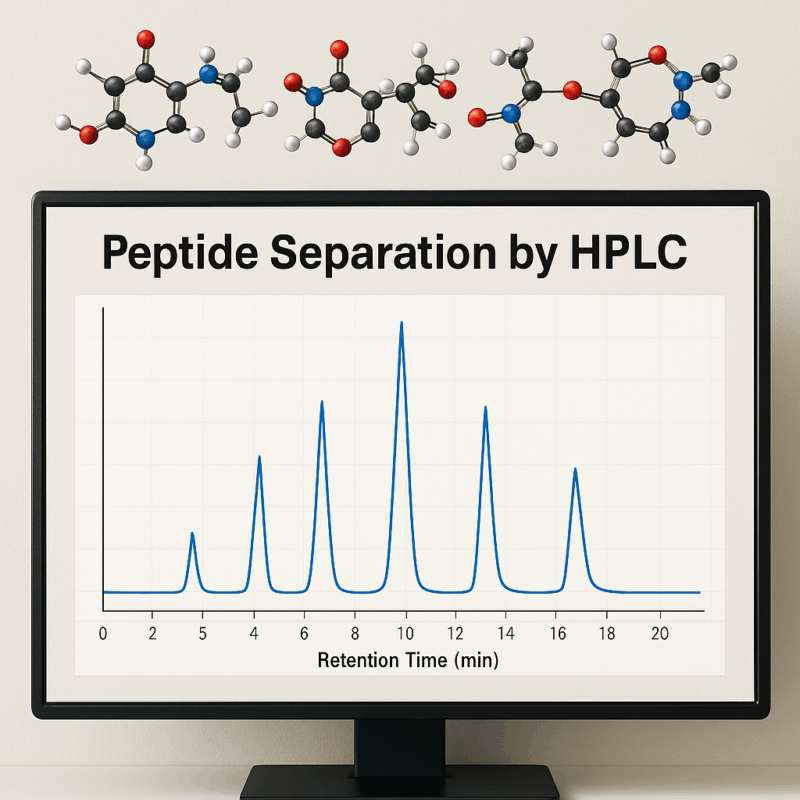
These can be especially troublesome due to the fact that their chromatographic actions is really comparable to the target peptide, making them more difficult to separate during filtration. When a peptide is 98% pure, that continuing to be 2% isn't random noise-- it's specific, identifiable sorts of results. Mass spectrometry measures the molecular weight of a substance with extreme accuracy. For peptides, the most typical methods are electrospray ionization (ESI-MS) and matrix-assisted laser desorption/ionization time-of-flight (MALDI-TOF). HPLC separates a mix into its private elements based on exactly how each molecule communicates with a particularly created column.Tests can be conducted using high-precision stabilization chambers, simulating different settings, Purity Testing and applying global criteria to examine short-term and lasting stability, important for constant peptide performance. Some peptides fail not since the series is wrong, yet since their physical habits in real solvents is badly recognized. We supply physical building screening that assists teams function more effectively with challenging examples. Mass spectrometry confirms whether the gauged mass matches the anticipated peptide mass. The chromatogram is one of the most important visual data component on an HPLC peptide examination report. It is a graph with time on the straight axis and detector feedback, generally UV absorbance, on the vertical axis.
As the percent of natural solvent gradually raises throughout the run, molecules are released from the column in order of their hydrophobicity-- the much more hydrophobic a peptide, the longer it requires to elute (wash off). Considering that impurities normally vary from the target peptide by at the very least one amino acid, they have a little different hydrophobicities and appear as separate heights on the chromatogram. The key point is not to confuse pureness (HPLC percent of the main peptide vs contaminations) with overall material. For speculative planning (like calculating molar focus), both purity and web material work numbers, but pureness is what mirrors the chemical homogeneity of the peptide example.
HPLC informs you what percentage of your example is the major compound-- but it does not validate what that main compound in fact is. A height with the right retention time could theoretically be an associated peptide with comparable hydrophobicity. Mass spectrometry offers identification verification by measuring molecular mass straight. We examine peptide length, sequence composition, expected molecular weight, modification type, salt type, sample history, and desired downstream use prior to specifying the analytical path. Desalted peptides work well for ELISA finishing, some cell-based assays, and applications where moderate purity is acceptable. After synthesis and filtration, peptides are typically lyophilized (freeze-dried) as salts. The most usual counterion is trifluoroacetate (TFA) from the HPLC filtration solvents, though some peptides are provided as acetate or hydrochloride salts. These counterions aren't "pollutants" in the HPLC sense-- they don't appear as separate optimals-- yet they do contribute to the total mass of the powder.